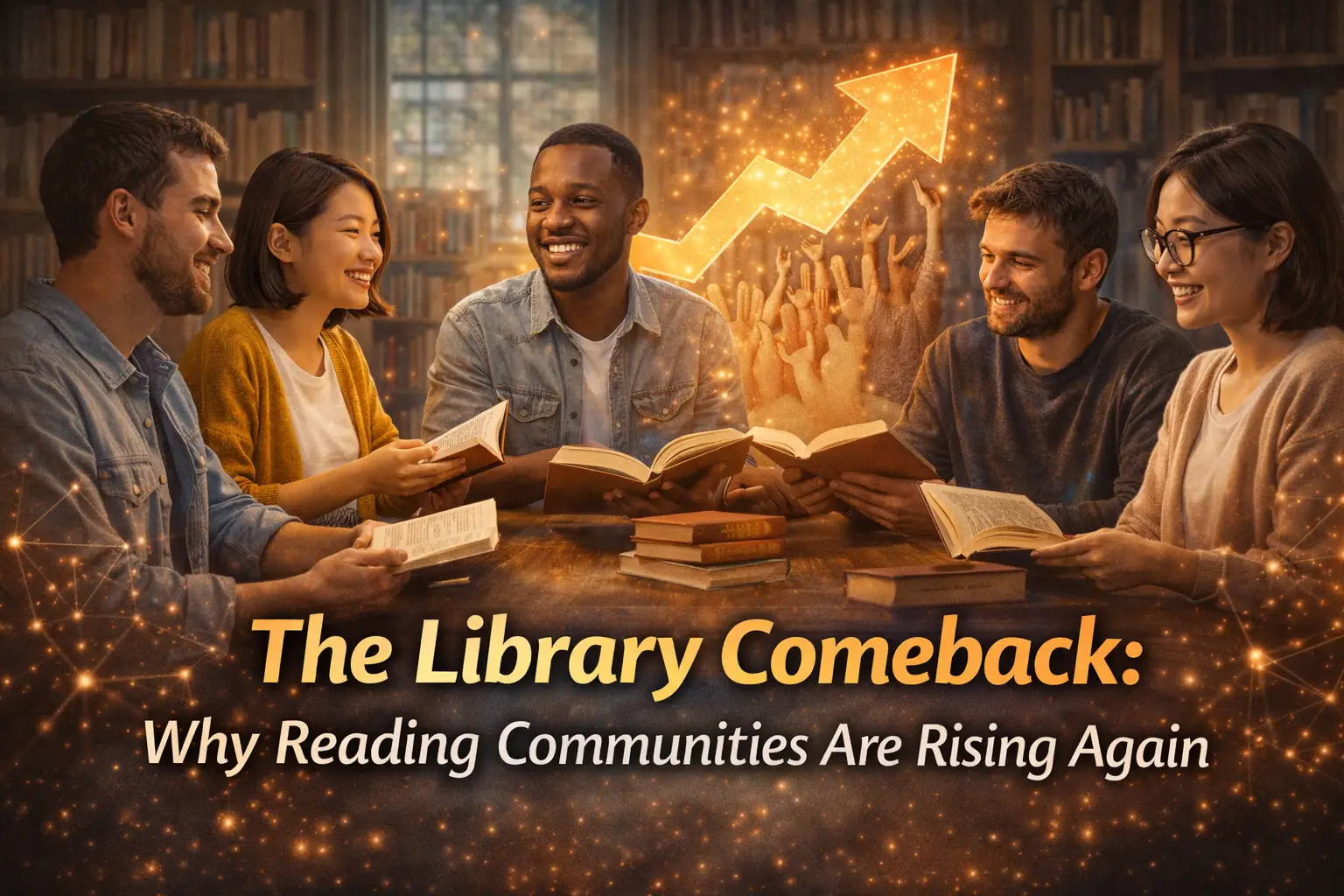
The Library Comeback: Why Reading Communities Are Rising Again
For a while, it seemed like libraries were fading into the background.
With the rise of smartphones, instant search engines, and endless digital content, many believed that traditional reading spaces would slowly disappear. Why go to a library when information is just a click away? Why sit with a book when videos, feeds, and short-form content dominate attention?
But something unexpected is happening.
Libraries—and more importantly, reading communities—are making a powerful comeback.
The Digital Overload Effect
Modern life is saturated with information. We are constantly consuming content—scrolling, clicking, watching—but rarely stopping to truly engage with what we see.
This has created a new kind of fatigue.
People are overwhelmed, distracted, and often mentally exhausted. The convenience of digital content has come at a cost: reduced focus, shallow engagement, and a sense of constant noise.
In response, many are searching for something different—something deeper.
And that’s where reading comes back into the picture.
A Return to Depth and Focus
Reading offers something the digital world often cannot—depth.
When you read, you slow down. You engage with ideas. You reflect. You give your full attention to something meaningful. In a world that rewards speed, reading restores balance.
Libraries have become a symbol of that balance.
They are quiet spaces designed for focus, learning, and reflection. But today’s libraries are evolving beyond physical buildings. They are becoming hubs for connection, creativity, and shared knowledge.
This evolution is giving rise to something even more powerful: reading communities.
The Rise of Reading Communities
People are no longer satisfied with consuming content alone. They want connection. They want conversation. They want shared experiences.
Reading communities provide exactly that.
Groups like the Library User Group are transforming the way people interact with books. Instead of reading in isolation, members come together to discuss ideas, share recommendations, and explore new perspectives.
A single book becomes a starting point for meaningful dialogue.
These communities create a sense of belonging—something that is increasingly rare in today’s fast-paced, digital-first world.
Why Now? Timing Matters
The comeback of libraries and reading communities isn’t random—it’s a response to cultural shifts.
As attention spans shorten and distractions increase, people are recognizing the value of focus. As digital connections grow, the need for meaningful interaction becomes stronger.
Reading communities meet both of these needs.
They offer a space to slow down, think deeply, and connect with others in a way that feels authentic and rewarding.
More Than Books—A Movement
What we’re seeing isn’t just a trend—it’s a movement.
Reading communities are becoming platforms for learning, creativity, and personal growth. They encourage people to challenge their thinking, explore new ideas, and build habits that lead to long-term success.
The Library User Group is part of this movement.
It brings together readers, thinkers, and creators who believe in the power of knowledge and shared experience. It’s not just about reading more—it’s about growing more.
The Future of Learning
As we look ahead, one thing becomes clear: the future of learning will not be defined by technology alone.
It will be defined by how we use that technology to create meaningful experiences.
Reading communities represent the best of both worlds. They combine access to information with human connection. They turn passive consumption into active engagement.
And in doing so, they create a richer, more impactful way to learn.
The Comeback Is Just Beginning
Libraries are no longer just quiet buildings filled with books. They are evolving into vibrant ecosystems of learning and connection.
Reading communities are at the heart of this transformation.
They remind us that while technology may change how we access information, the need for knowledge, focus, and connection remains the same.
The comeback is real—and it’s just getting started.
We write rarely, but only the best content.
