
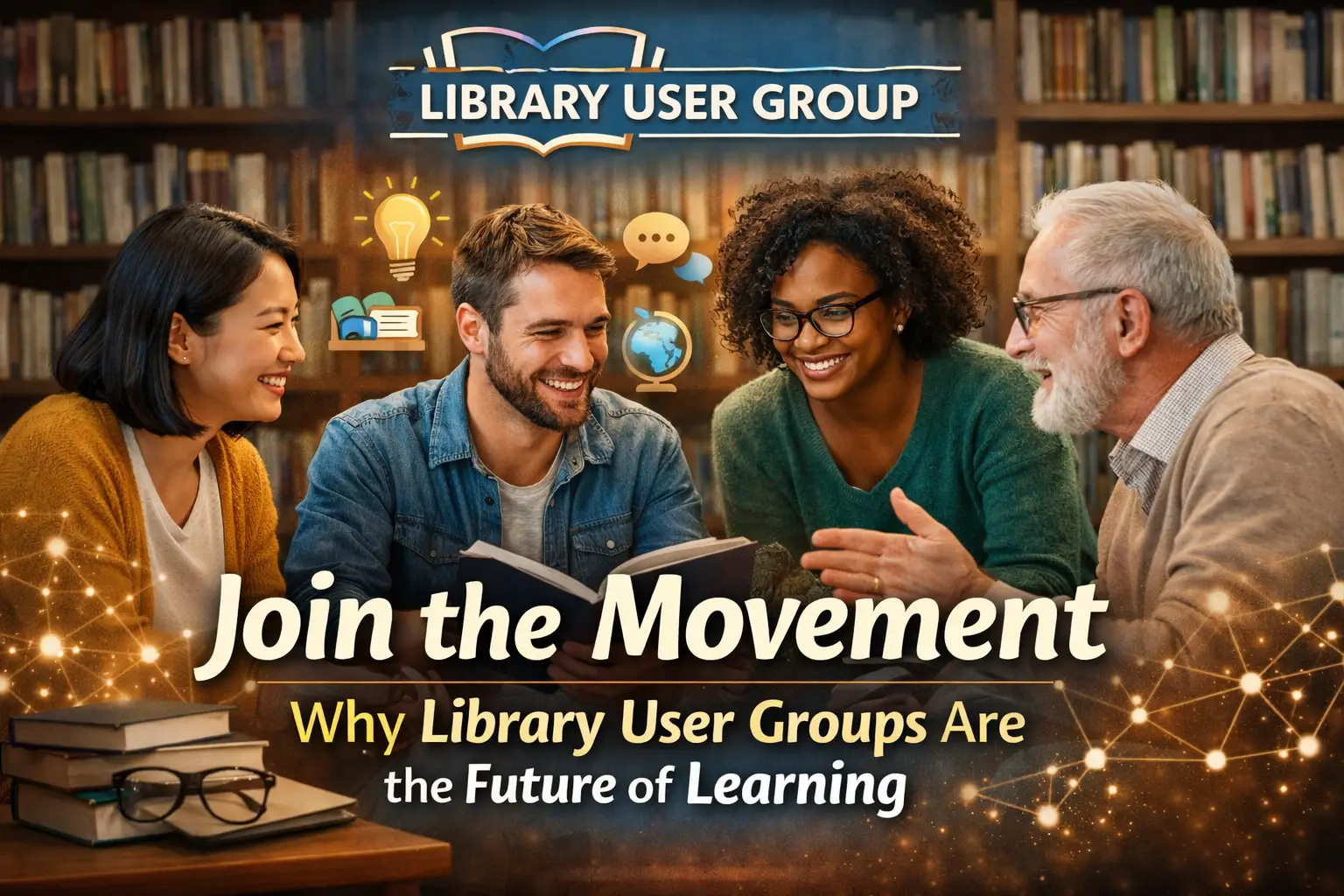
Join the Movement: Why Library User Groups Are the Future of Learning
The way we learn is changing.
For decades, education followed a familiar path—classrooms, textbooks, structured lessons, and one-way instruction. Then came the digital revolution, bringing instant access to information, online courses, and endless content at our fingertips. While this transformation made learning more accessible, it also created a new challenge: too much information, not enough connection.
Today, people aren’t just looking for access to knowledge—they’re looking for meaningful ways to engage with it.
That’s where Library User Groups come in.
What once started as simple reading circles is now evolving into something far more powerful—a modern learning movement built around community, collaboration, and continuous growth.
From Information to Engagement
We live in an age where information is abundant.
You can search almost anything, watch tutorials on any topic, and access thousands of books instantly. But having access to information doesn’t guarantee understanding.
True learning requires engagement.
It requires discussion, reflection, and the ability to connect ideas in meaningful ways. This is where traditional self-learning often falls short—and where library user groups excel.
In a library user group, learning becomes interactive. Instead of simply consuming information, members engage with it. They ask questions, share insights, and explore ideas together.
This transforms learning from a passive activity into an active experience.
The Power of Community Learning
One of the most significant shifts in modern learning is the move toward community-based experiences.
People learn better together.
When individuals come together around shared interests, they bring different perspectives, experiences, and ideas. This diversity strengthens understanding and deepens knowledge.
The Library User Group embodies this approach.
It creates a space where readers, learners, and thinkers connect—not just to read, but to grow. Conversations bring new meaning to content. Discussions uncover insights that might otherwise go unnoticed.
Learning becomes a shared journey rather than a solitary task.
Building Lifelong Learning Habits
The future of learning isn’t limited to schools or formal education—it’s continuous.
In a rapidly changing world, the ability to keep learning is more important than ever. Skills evolve, industries shift, and new ideas emerge constantly.
Library user groups support this by encouraging consistent engagement.
Instead of learning in short bursts, members develop habits that last. Reading regularly, participating in discussions, and exploring new topics becomes part of everyday life.
This consistency is what turns learning into long-term growth.
A Space for Creativity and Ideas
Learning isn’t just about absorbing information—it’s about creating something with it.
Library user groups foster creativity by encouraging members to think beyond the page. Ideas spark new ideas. Conversations lead to innovation. Inspiration turns into action.
Whether it’s writing, problem-solving, or simply seeing things differently, the environment supports creative thinking.
In many ways, these groups become incubators for new ideas and personal breakthroughs.
Balancing Technology and Human Connection
Technology has made learning faster and more efficient—but it has also made it more isolated.
Many people learn alone, through screens, without interaction or feedback. While this can be effective in some ways, it often lacks depth and connection.
Library user groups bridge this gap.
They combine the accessibility of modern information with the richness of human interaction. Members can explore digital resources while still engaging in meaningful conversations.
This balance is what makes them so powerful.
Why Library User Groups Matter Now
The rise of library user groups is not a coincidence—it’s a response to what people are missing.
In a world filled with quick content and surface-level engagement, people are craving depth. They want to understand, not just consume. They want to connect, not just observe.
Library user groups provide that opportunity.
They offer a place where learning slows down, conversations matter, and ideas have room to grow.
Join the Movement
The future of learning isn’t just about technology—it’s about how we use it to connect, grow, and think more deeply.
Library user groups represent a shift toward more meaningful, community-driven learning experiences. They are not just a trend—they are a movement.
And that movement is growing.
The Library User Group invites you to be part of it.
Whether you’re looking to read more, learn something new, or connect with others who share your curiosity, this is your opportunity to step into a new way of learning.
Because the future doesn’t belong to those who simply access information.
It belongs to those who engage with it.
We write rarely, but only the best content.
